What you need to know about soil
- colefraser1984
- Jun 9, 2025
- 6 min read

Soil is undoubtedly one of the most important aspects of growing anything. Soil has formed over millennia from parent materials of mountains and volcanoes, and from powerful natural events such as the ice age. In Canada we have ten major divisions of soil orders. Classified largely on the presence or lack of soil horizons in a given area, and the primary environmental forces that helped create them. From these general classifications, soil is further defined into Great groups, sub groups, and so on. More detailed analysis leads to more classifications. It is in fact its own science! Below is a breakdown of basic soil horizons that form, and for the purpose of this post we as gardeners are concerned with O, A, and E!
O Horizon: Organic layer, made up of decomposing plant and animal material.
A Horizon: Topsoil, the layer where most plant roots grow.
E Horizon: Leached layer, where minerals have been washed out.
B Horizon: Subsoil, denser and richer in minerals than the topsoil.
C Horizon: Parent material, the partially broken-down rock from which the soil formed.
R Horizon: Bedrock, the solid rock layer beneath the soil.
Soil hosts an incredible abundance of life and plays a vital role in our ecosystems. It has a significant capacity for carbon storage, potentially serving as a critical factor in mitigating the carbon gases that contribute to the greenhouse effect. More scientists are working on understanding its total capacity to hold carbon. But, Soil is a living entity with its own food web and intricate networks of remarkable connections. Healthy soil, leads to healthy plants. Plants and soil biota have co-evolved and some of these beneficial relationships can be utilized by gardeners to improve their soil. Sometimes my suggestion of specific plants will be entirely based on a need to replenish the soil or support "hefty feeders" in your garden. I will always encourage organic matter (mulch). But, this blog will help you understand why I want you to apply mulch.


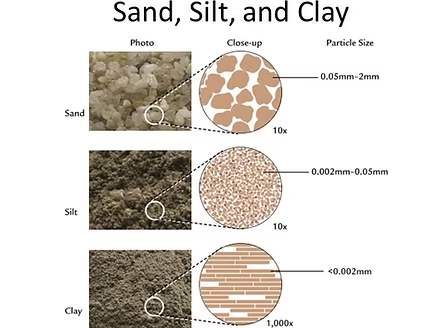
The three main soil particles, ranked from smallest to largest, are clay, silt, and sand. Their size and arrangement determine how water flows through the soil. In very sandy soil, gravity is the dominant force, causing water to drain rapidly and reducing its ability to retain moisture. Clay particles, on the other hand, are small, closely packed, and charged. Water moves through clay primarily due to capillary action. If this seems confusing, let's quickly review some chemistry!
Water is a polar molecule composed of two hydrogen atoms and one oxygen atom. Each atom has protons (positive charge) and electrons (negative charge) orbiting around it. When oxygen and hydrogen bond, the larger oxygen atom has a positive charge density from its many protons, attracting the electrons of the hydrogen atoms closer to it than to the single proton in hydrogen. This leaves a partial positive charge exposed on the hydrogen, and the oxygen atom hogging the electrons has an overall negative charge. Thus, water molecules are polarized, meaning they have distinct charged areas. This polarity gives water cohesion (it sticks to other water molecules) and adhesion (it sticks to other charged molecules). Plants of all kinds utilize this chemistry to their advantage. Organizing their cellular structures to utilize this fundamental chemistry in diffusion, osmosis, in vascular tissues, and in drawing water hundreds of feet up the plant to the leaves. Its rather incredible in design.
However, clay has the ability to retain water and doesn't release all of it. This is a crucial concept for understanding your soil and the reason gardeners strive for loamy soil. Ideally, this consists of 40% sand, 40% silt, and 20% clay—a dark, fertile, easily workable, and water-retentive medium for plant growth. Nevertheless, many plants can endure heavier clay, like those persistent buttercups or extremely drought-tolerant species that can thrive in rock crevices or pure sands. In fact, some require extremes. That is why knowing what you garden soil is, is so beneficial to know.
When water starts to contact the soil, it moves through each layer separately, with its primary forces determining the type of movement observed. In soils rich in clay, water clings to the charged particles in the clay and completely saturates it. If this concept is difficult to grasp, try this: take a small plate, create a tiny puddle of water, touch the tip of a paper towel to it. Observe how the water moves upward and sideways. This is capillary action at work. This is how water acts in clay. If your soil is mostly clay it most certainly is going to be wet. But, a beautiful mix of particles means that you get air, drainage, good water movement, and healthy plants.
Currently, there are numerous soil jar tests available to help you figure out your basic soil proportions. These tests take approximately five days to yield results, and you can find plenty of them online if you're looking for a fun experiment to do with your kids. There are also just simple tests you can do by hand to give you a good idea of what kind of soil you have. But, you must consider whether you want a layer of clay on the surface with sand beneath it, or sand on top with clay underneath. It matters. The way these particles are arranged in the soil can influence how water flows through your yard, and if the water will pass right on by some roots before they have had a chance to drink.
Heavy clay soils can keep roots wet and deprived of oxygen, which can destroy root cells. This leads to root rot and allows parasitic bacteria or fungi to invade, causing your plant to exhibit signs of distress. Therefore, gardeners strive for loamy soil, which is a well-balanced medium that retains water, is nutrient-rich, and drains excess water efficiently. So, how can we promote healthy soils? Applying organic matter!
Let's return to our discussion on soil biota. The soil hosts its own food web, and as plants decompose, these biota spring into action. Larger organisms like caterpillars and ants begin the process by breaking down bigger pieces into smaller ones. Subsequently, another group of biota further decomposes, ingests, digests, and excretes, continuing the process until it reaches the smallest life forms. The presence of these microorganisms in your soil can easily replace any fertilizer tenfold! In my view, the most beneficial groups of soil biota are bacteria and fungi (mycorrhiza). All these organisms reside within 4mm of a plant root, or encapsulate in the root (nitrogen fixing bacteria) and maintaining their health can mean the difference between life and death for plants in rapidly changing ecosystems. These mycorrhizae can form networks so extensive that they could span hundreds of miles in mature forests. Providing your plants with water and nutrients, your plants exchange glucose in return. This represents a symbiotic relationship that has coevolved over millennia. In our ever-changing climates, it's crucial to acknowledge soil as a living entity. By taking the right steps, soil can offer a greater bounty in your garden than any fertilizer. To achieve this, we apply organic matter.

When the top layer of soil is continuously exposed to sunlight and winds, evaporation and erosion occur. Soil organisms struggle in these conditions due to the lack of moisture and food, and the harmful effects of sun radiation decimate them. Consequently, we miss the opportunity to sustain a thriving ecosystem. While plants are resilient and we can continue to support them. We could be creating sustainable ecosystems right in our gardens. Full of diverse life, supporting all living organisms, simply by applying that organic matter. Our soils remain full of nutrient, hold moisture, keep arid, do not compact, and we keep that loamy soil and our beneficial friends.
Although I understand that this topic is quite complex, you get the general idea. Maintaining soil health and creating a suitable environment for these organisms is crucial for the well-being of your landscape. It involves preventing harmful bacteria and fungi while attracting beneficial insects, worms, and healthy bacteria and fungi. By mulching, you are doing far more than just controlling weeds; you are offering a habitat and a lifeline to your plants in these changing times. A powerhouse that can grow further and faster than any root. If you want any assistance in assessing your soil, amending it, or mulching, you can find me here.
Happy mulching!


Comments